von Hanf Hemp blocks
EN ▾
Shop →
Hemplith hemp block made of hemp shiv, lime and clay
Hemplith® hemp-lime block/Properties, formats, installation

Masonry and insulation in one building material. Made of hemp shiv and lime, for external walls, internal walls and insulating existing buildings.

FORMATS
590 × 285 to 600 × 308 mm
THICKNESSES
70–320 mm
THERMAL CONDUCTIVITY λ
0.069–0.071 W/(m·K)
DRY DENSITY
approx. 300–320 kg/m³
REACTION TO FIRE
B-s1, d0 · all block types

Value range across all Hemplith® block types: hemp block (Block PL), Block FR and Modular. Values for each type are given in the tables below.

Components

What a hemp block is made of

Drag to rotate the block. The slider separates it into hemp shiv, lime, clay and water.

Material

What is a hemp block?

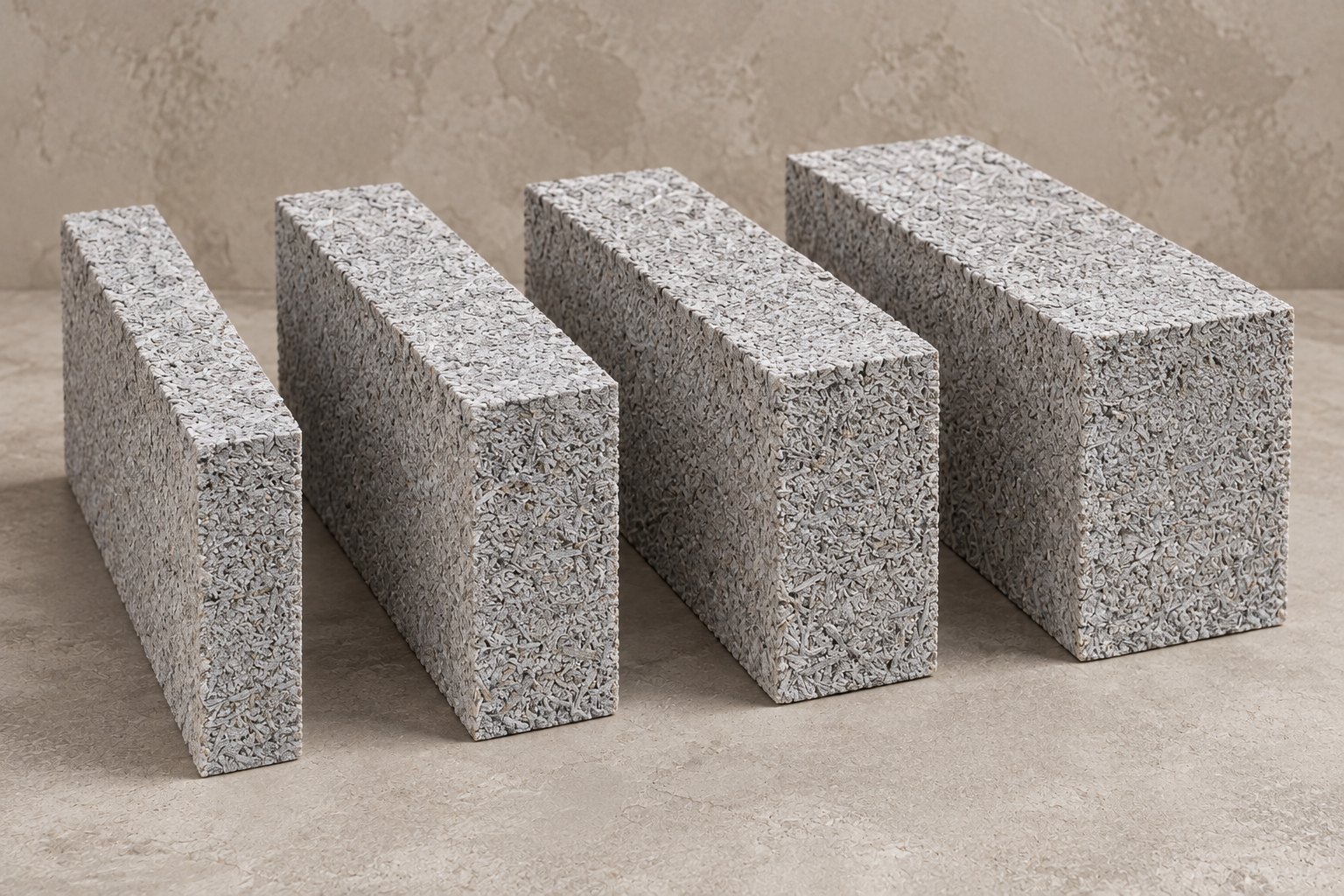
A hemp block is a prefabricated masonry block made of hemp shiv and a mineral binder. It insulates, stores heat and buffers moisture, and it is laid like an aerated concrete block.

Shiv is the woody core of the hemp stalk. It is light and porous and is produced alongside the fibres when industrial hemp is harvested. Bound with lime, it forms a mineral building material that has been known for centuries: hemp and lime were already combined in historic buildings. Hemplith® hemp blocks are moulded and dried in the factory; the Block PL hemp block also contains clay in addition to shiv and lime.

Several names are used in the trade for the same principle. Hemp block, hemp-lime block and hemp and lime block refer to the prefabricated block. It is sometimes called a hemp brick , although it is not fired. Hempcrete or hemp-lime, by contrast, refers to the mix that is tamped or sprayed into formwork on site and has to dry there for weeks. With a hemp block, this drying has already taken place in the factory.

In the wall, the hemp block performs two tasks that would otherwise need two layers: it closes the wall and it insulates. A 285 mm hemp block wall achieves a calculated U-value of 0.23 W/(m²·K) without an additional insulation board.

Important

Hemp blocks are not load-bearing. Without project-specific structural and regulatory verification, Hemplith® hemp blocks do not carry loads from floors or the roof. They are combined with a load-bearing structure, such as a timber stud frame, a timber or steel skeleton or a solid wall, and fixed to it with 4 to 5 anchors per m².

Formats

Formats and U-values

Base size 590 × 285 mm, seven thicknesses, 5.7 blocks per m² of wall.

The thickness depends on the application and the required thermal insulation. The slim 70 and 110 mm formats are intended for linings, internal insulation and internal walls. From 150 mm the block is suitable for infill in timber and skeleton construction. 200 and 250 mm are the usual thicknesses for insulated external walls. With 285 and 320 mm, the wall reaches values that allow new builds to do without an additional insulation layer.

For context: when renovating an external wall in an existing building, the German Building Energy Act (GEG) generally requires a U-value of no more than 0.24 W/(m²·K). By calculation, the hemp block alone achieves this from 285 mm; with thinner blocks, the existing wall, plaster and other layers contribute to the result.

Hemplith® hemp block (Block PL), format 590 × 285 mm: properties by thickness
FormatR in m²·K/WU-value in W/(m²·K)kg per blockBlocks per palletm² per palletTypical usePurchase
Hemp block 70 mm
1.010.843.79015.8Lining, internal insulationShop →
Hemp block 110 mm
1.590.575.9549.5Internal walls, linings, infillShop →
Hemp block 150 mm
2.170.438.0427.4Infill, internal wallsShop →
Hemp block 200 mm
2.900.3310.7305.3Highly insulated external wallShop →
Hemp block 250 mm
3.620.2613.4244.2External wall without additional insulationShop →
Hemp block 285 mm
4.130.2315.2––External wall, new buildon request
Hemp block 320 mm
4.640.2117.1––External wall, very high thermal insulationon request

Calculated U-values for the bare block wall: λ 0.069 W/(m·K), Rsi 0.13 and Rse 0.04 m²·K/W, without plaster and joints. Weight based on the dry density of 318 kg/m³; on delivery the block is heavier due to residual moisture. For the energy assessment, your designer's design value applies. Dry R according to the technical data sheet. Pallet data for 285 and 320 mm on request.

Dry density
318 ± 10 kg/m³
Diffusion resistance factor μ
6.51
Capillary water absorption
8.3 g/(m²·s)
Composition
Hemp shiv, lime, clay

Basis: Declaration of Performance No. 005/2026.

Range

More hemp block systems: Block FR and Modular

Besides the hemp block in the 590 × 285 mm format, there are two further Hemplith® hemp-lime systems: a block in the 600 × 300 mm format with lime as the only binder, and a wall system whose blocks also form the formwork for a reinforced concrete frame.

Wall made of Hemplith Block FR hemp-lime blocks

Hemplith® Block FR

λutile 0.071 W/(m·K)B-s1, d0Emissions A+FDES (INIES)

Block FR is a solid hemp-lime block made of hemp shiv, lime and water for insulating walls and infill, available in four thicknesses from 100 to 300 mm. It is suitable for non-load-bearing external and internal walls, infill in solid, skeleton and timber frame construction, internal insulation, linings and partition walls, and for insulating roofs and floors. It is laid in thin-bed with adhesive mortar or in thick-bed with masonry mortar, in both cases lime- or clay-based. An environmental product declaration (FDES, INIES) is available for 200 and 300 mm.

Format 600 × 300 mm, 5.5 blocks per m²
ThicknesskgR in m²·K/WBlocks per pal.m² per pal.
100 mm71.4112021.6
150 mm112.118014.4
200 mm142.826010.8
300 mm214.23on request

Basis: Declaration of Performance No. 006/2026.

Hemplith Modular wall system made of hemp-lime blocks

Hemplith® Modular

R 4.21 m²·K/WEI 90REI 30 with frameRw 43 dB

Hemplith® Modular is a non-load-bearing wall system of hemp-lime blocks that also act as permanent formwork for a reinforced concrete post-and-beam frame. It is designed for external walls with distributed insulation in residential, public and commercial buildings with a ground floor and no more than one upper floor, with a storey height of no more than 3.00 m. The blocks are laid dry with tongue and groove, without mortar, and the posts and beams are cast in the cavities. The loads are carried by the reinforced concrete frame.

Dimensions W × L × H 300 × 600 × 308 mm, 5.4 blocks per m², 24 blocks or 4.4 m² per pallet
Block typeWeightCavity
Standard blockapprox. 21 kg–
Post blockapprox. 16 kg150 × 150 mm
Double post blockapprox. 15 kg2 × 150 × 150 mm
U-shellapprox. 14 kg150 × 220 mm

λutile 0.071 W/(m·K) · compressive strength ≥ 0.2 MPa · dry density ≤ 302 kg/m³ · emissions A+ · basis: Declaration of Performance No. 007/2026.

Practice

Typical wall build-ups

Three build-ups that are often planned with Hemplith® hemp blocks. They do not replace professional design, but show how the block works together with the structure and plaster.

External wall in timber or skeleton construction

  1. outsideLime plaster, vapour-permeable
  2. Hemp block250, 285 or 320 mm
  3. StructureTimber studs or skeleton, hemp block anchored
  4. insideLime or clay plaster

At the base, a barrier against rising damp goes under the first course; seal the splash zone separately. Calculated U-value of the block layer at 285 mm: 0.23 W/(m²·K).

Internal insulation of an existing wall

  1. outsideExisting masonry, unchanged
  2. Adhesivevapour-permeable lime mortar, full-surface
  3. Hemp block70–320 mm
  4. insideLime or clay plaster

For listed façades and half-timbered buildings that may not be insulated externally. For internal insulation, a hygrothermal simulation (for example WUFI) is recommended, especially on walls exposed to driving rain.

Internal and partition wall

  1. Side ALime or clay plaster
  2. Hemp block110 or 150 mm
  3. Side BLime or clay plaster

Non-load-bearing wall with mass and a mineral surface. Services are chased with a wall chaser and refilled with crushed hemp block and binder.

Applications

Where hemp blocks are used

  • Single and multi-family houses, commercial buildings: as an external wall in combination with a load-bearing structure.
  • New builds in timber, solid or prefabricated construction: as infill, facing masonry or service layer.
  • Partition and internal walls: with thermal mass, sound damping and a mineral surface.
  • Internal insulation of existing buildings: capillary-active and vapour-permeable where the façade must be preserved.
  • Old buildings, half-timbering and listed buildings: compatible with the lime and clay plasters of historic buildings.
  • Under the floor: as an insulation layer below the floor build-up.
  • Acoustic walls: The open structure dampens sound; the effect depends on the entire build-up.
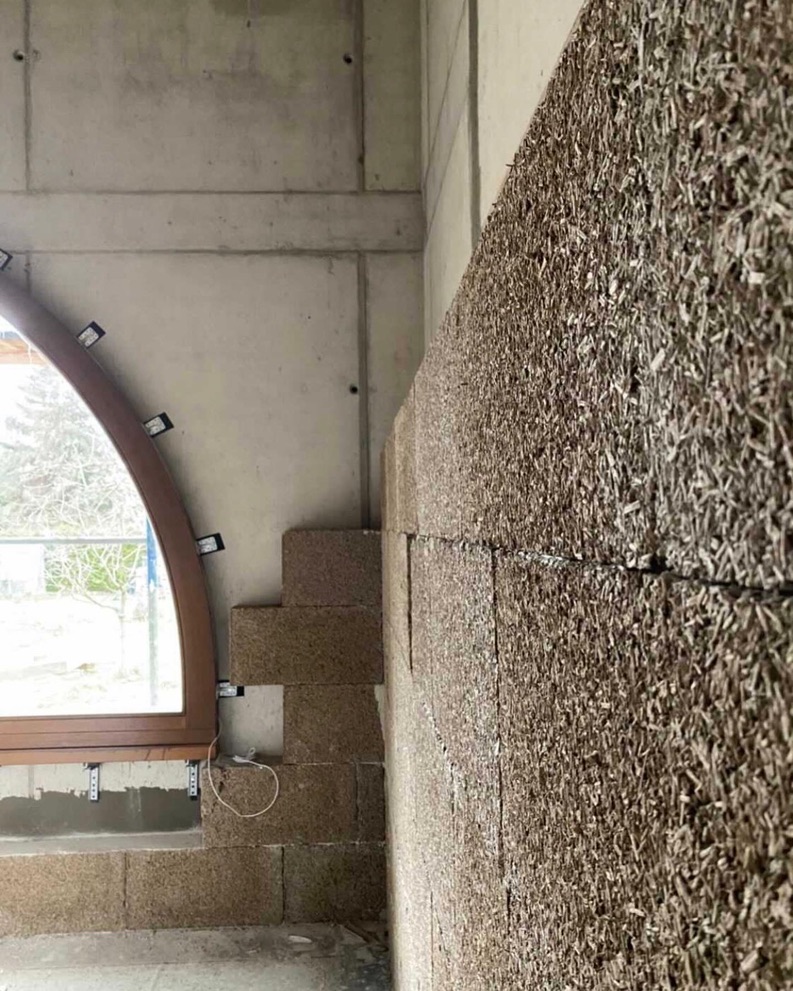
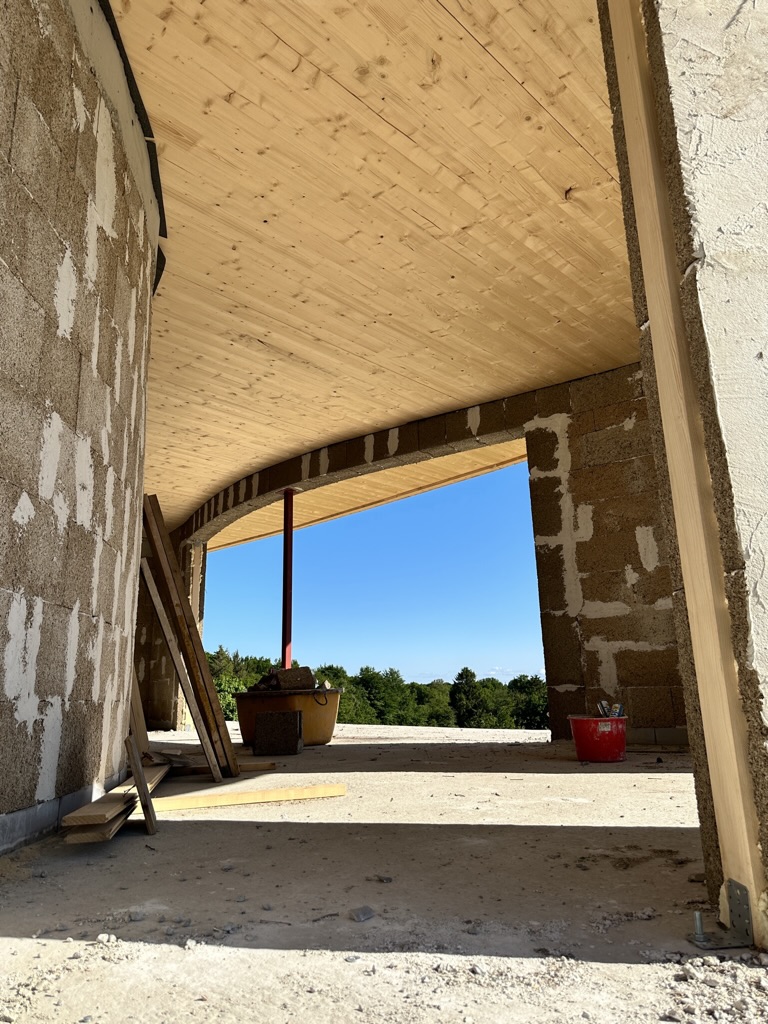
Hemplith hemp blocks in a timber frame with lintel
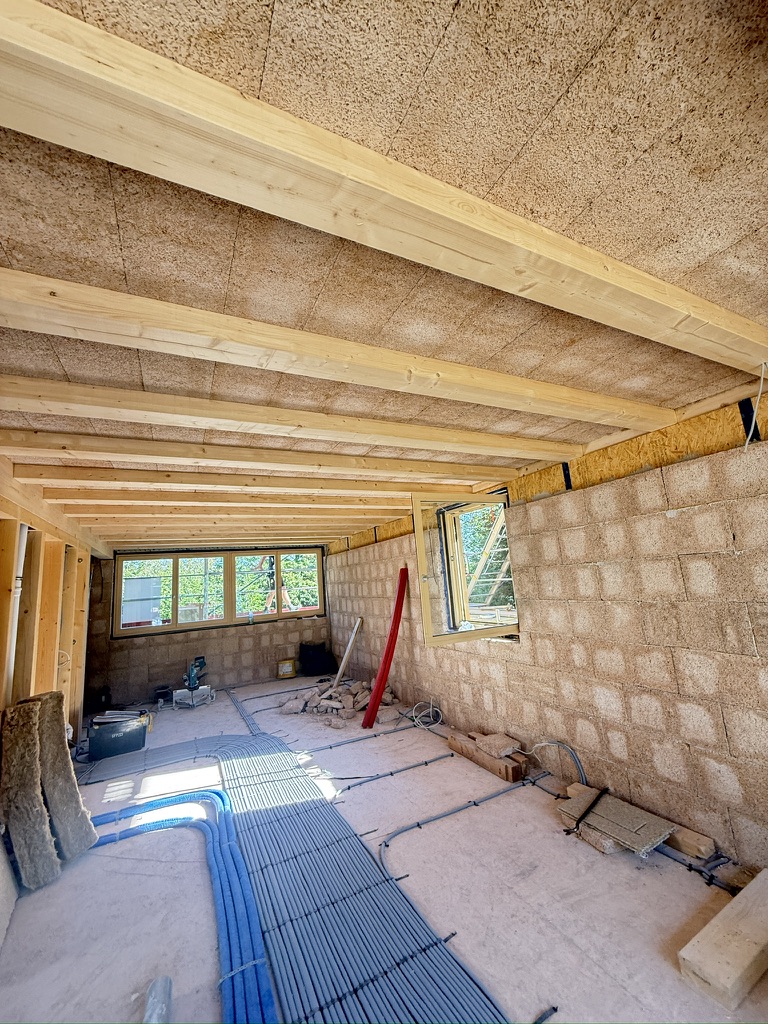
Wall detail with Hemplith hemp blocks
Hemp block wall below a timber ceiling
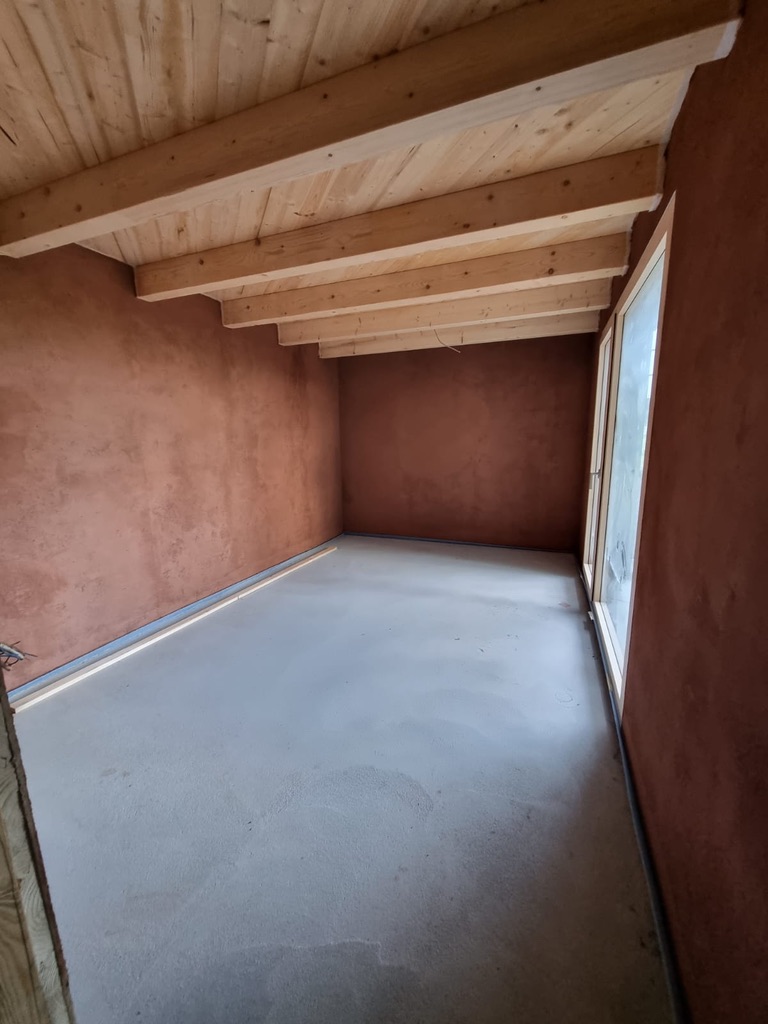
Room with clay finish on a hemp block wall
Properties

Building physics without exaggeration

What the block does and where the design has to complement it.

Thermal insulation and thermal mass

With λ 0.069 W/(m·K), the hemp block insulates well without matching pure insulation materials. Its advantage is the combination with mass: 318 kg/m³ and mineral binding mean that the wall absorbs heat and releases it slowly. This smooths temperature peaks and helps with summer heat protection, especially under the roof and in timber houses that otherwise lack thermal mass.

Moisture

Hemp block is vapour-permeable and capillary-active. It absorbs water vapour from the room air and releases it again, and distributes liquid moisture through its pores. This dampens fluctuations in indoor humidity. The alkaline lime inhibits mould. Vapour-permeable does not mean moisture-proof, however: airtightness, driving-rain protection, sealing at the base and adequate ventilation still have to be planned. Air leaks bring considerably more moisture into a wall than diffusion.

Fire protection

Hemplith® hemp blocks are classified B-s1, d0 according to EN 13501-1: flame-retardant, low smoke production, no flaming droplets. This is a product class. How long a finished wall resists fire (for example EI 30 or EI 60) depends on the tested overall build-up.

Sound

The open structure dampens sound, and the mass helps with sound insulation between rooms. Specific airborne sound insulation values depend on mass, cavity width, decoupling, flanking paths and workmanship and cannot be given as a general figure.

Pests and service life

As a mineral-bound building material, hemp block offers no food to rodents and insects. Hemp-lime components from historic buildings show that the combination lasts for generations.

Reference

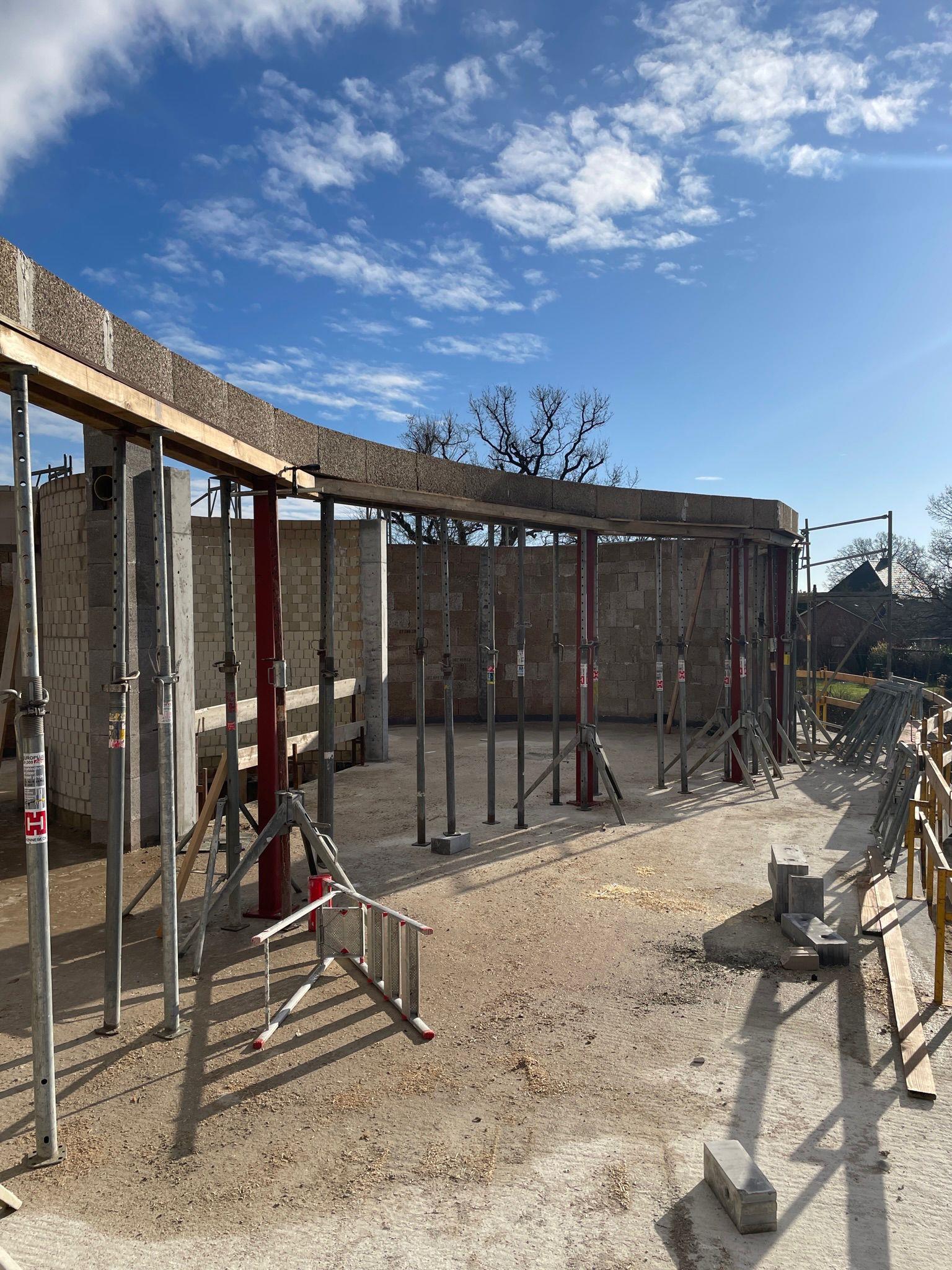
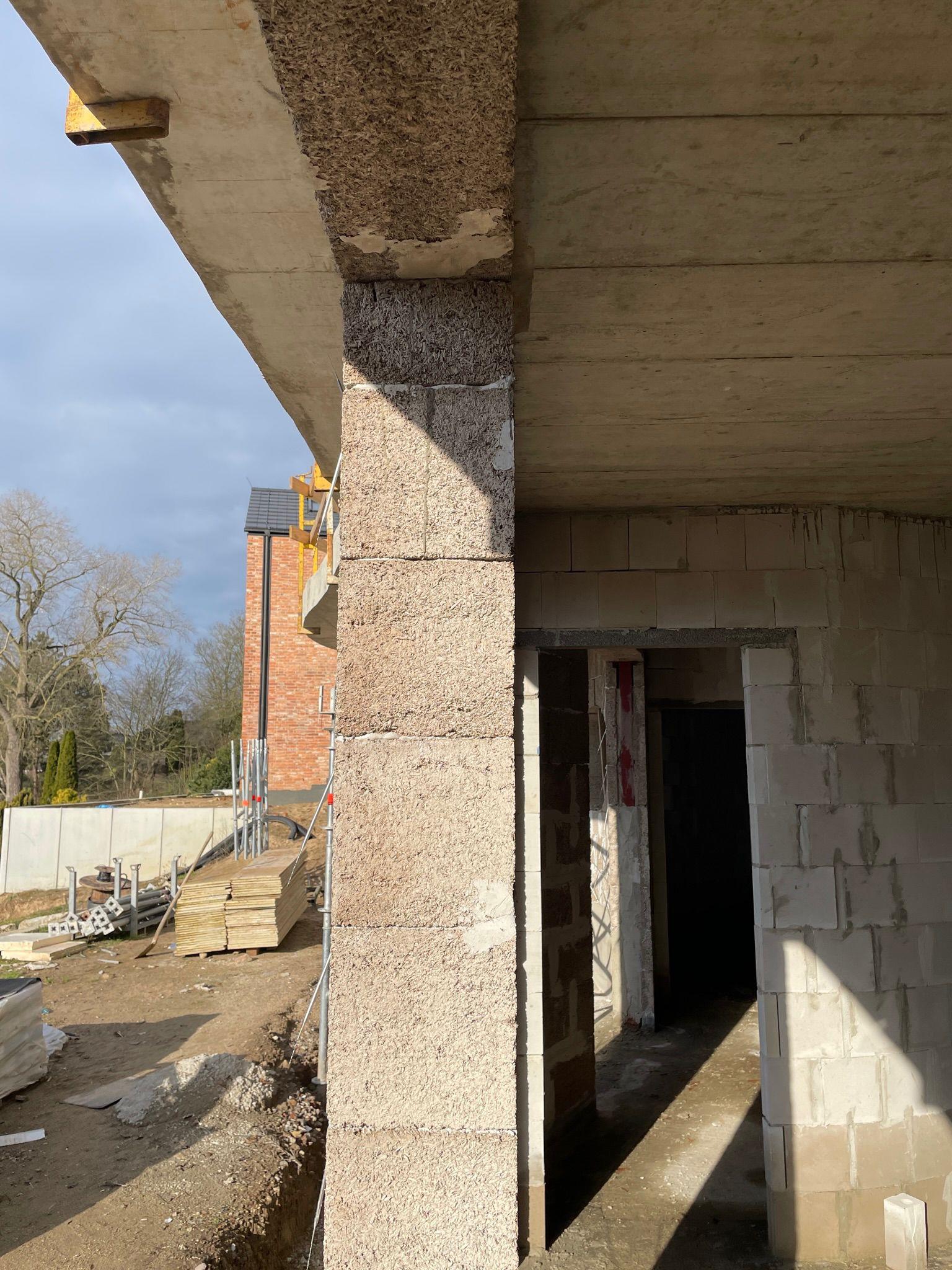
New build Stuttgart, IBA’27

Project in the network of the International Building Exhibition 2027 StadtRegion Stuttgart.

New build in Stuttgart with Hemplith hemp blocks

A three-storey single-family house shows how far hemp building materials can be used in new builds: from the façade to beneath the screed.

  • Recycled concrete base on the slope, timber frame above, mansard roof with clay tiles
  • Hemplith® hemp blocks in external walls and ceilings, as a service layer and as exposed ceiling elements
  • Plus Hemplith® Therm on the façade, Hemplith® Drywall for internal walls and the roof, Hemplith® Fill under the underfloor heating
  • Lime and clay plasters inside, lime plaster outside
  • Groundbreaking 3 March 2026, hemp blocks in the ceilings in May, topping-out 3 June 2026
  • Architecture: larob. studio für architektur; design: atzinger consulting
Stuttgart new build project page on vonhanf.de →
Climate

CO₂ in the wall

Hemp absorbs CO₂ from the air as it grows. The carbon remains bound in the shiv for as long as the wall stands. As it hardens, lime reabsorbs part of the CO₂ released during burning. Hemp grows back quickly and can be grown and processed regionally.

von Hanf states that the CO₂ balance of Hemplith® hemp blocks is negative: the building material stores more carbon than is emitted during its production. For the life cycle assessment of a specific building, however, the build-up, transport and service life count; designers need reliable data for this. Ask us for the current documents.

Offcuts and leftovers can be crushed and reused, for example to fill service chases. The blocks consist of mineral and plant-based raw materials with no plastic content.

Comparison

Hemp block, aerated concrete, mineral insulation board, wood fibre

Hemp block insulates less well than a pure insulation material, but replaces masonry and insulation with a single material. Values for aerated concrete, mineral insulation boards and wood fibre are typical ranges and vary by product.

Hemplith® hemp block Aerated concreteMineral insulation board Timber studs with wood fibre
Load-bearingnoyesno, insulation layer on a load-bearing wallstuds carry the load
λ in W/(m·K)0.069approx. 0.07–0.16approx. 0.042–0.045approx. 0.038–0.05
Thermal masshighmediumlowlow to medium
Moisture behaviourcapillary-active, hygroscopiccapillary-activecapillary-active, vapour-permeablehygroscopic
Reaction to fireB-s1, d0A1A1wood fibre mostly E
CO₂stores biogenic carbonEmissions from cement, lime and autoclavingEmissions from cement, lime and autoclavingstores biogenic carbon
Layersone plus plasterone to two plus plasterwall plus insulation board plus plasterseveral
Site

Storage and transport

  • Outdoors, protected from rain: can be stored for up to six months; indoors for up to two years.
  • On site, store in a ventilated indoor space or under a roof, otherwise cover with a tarpaulin that lets air circulate at the sides.
  • When it rains, cover the top of walls under construction.
  • Avoid impacts and rough handling. Coordinate delivery dates with construction progress.
  • Hemplith® Modular dries in the factory for at least 28 days before delivery.
Health and safety

Safety instructions

  • Lime-based mortars and plasters are alkaline: avoid contact with skin and eyes, wear safety goggles, work gloves and clothing that covers the body.
  • When sawing and chasing, extract dust at the source and wear respiratory protection if dust is generated.
  • Observe the safety data sheets of the mortars and plasters used.
Technical data sheets and declarations of performance →
Quantities

Pallet quantities and purchase

Hemplith® hemp blocks are sold by the pallet. Small quantities are available directly in the online shop hemplith.com; larger projects, the 285 and 320 mm formats and dealer terms on request.

FormatBlocks per palletm² per pallet
Hemp block 70 mm9015.8
Hemp block 110 mm549.5
Hemp block 150 mm427.4
Hemp block 200 mm305.3
Hemp block 250 mm244.2
Hemp block 285 mmon request
Hemp block 320 mmon request––on request

Block requirement 5.7 blocks per m² of wall. Availability and terms in the online shop or on request.

Calculator

Quantity calculator

Enter the wall area without windows and doors, choose the format and adjust the waste allowance. The calculator rounds up to whole blocks and whole pallets.

Blocks
–
Pallets
–
Blocks left over
–

Excluding mortar, adhesive and anchors.

Example

How to calculate your quantity

An internal wall of 4 × 2.5 m with 110 mm hemp blocks: 10 m² × 5.7 blocks = 57 blocks, with 5% waste 60 blocks. That is two pallets of 54 blocks each. The remaining blocks can be used for reveals, levelling or later additions.

How much waste?

For rectangular walls with few openings, less than 5% is usually enough. For gables, slopes and many openings, allow 10% or more. Deduct windows and doors, but include reveals and junctions.

What else you need

  • Levelling mortar for the first course and Hemplith® adhesive or lime mortar for the joints
  • Wall ties for fixing to the load-bearing structure, 4 to 5 per m²
  • Damp-proof membrane under the first course for external walls and damp substrates
  • Lime or clay plaster inside and outside

Delivery

Hemp blocks are delivered on pallets. Delivery time is usually 1 to 4 weeks. Clarify access, unloading equipment and a level, dry storage area in advance. The pallets are not airtight and must be protected from rain; covered outdoors for no more than six months, in a warehouse for up to two years. Outside the EU, delivery is ex works.

Installation

Installing hemp blocks: step by step

Anyone who can lay aerated concrete can lay hemp blocks. The differences lie in pre-wetting, anchoring and plastering.

Summary of the installation instructions. The current data sheet and your professional design are authoritative.

Download the installation guide ↗
  1. 01

    Plan

    Clarify with your designer and structural engineer the connection to the structure, the position of the anchors (4 to 5 per m²), lintels and junctions. Hemp blocks are not load-bearing; permissible wall heights depend on the structural system, wind, bracing and openings. For internal insulation, a hygrothermal simulation is recommended.

  2. 02

    Delivery and storage

    Store pallets level, dry and protected from rain. Covered outdoors for no more than six months, in a warehouse for up to two years. Do not place blocks directly on damp ground.

  3. 03

    Base and first course

    For external walls and damp substrates, a barrier against rising damp goes under the first course. The first course of blocks is set in a 1 to 2 cm levelling mortar bed and aligned exactly level and true. The whole wall depends on it.

  4. 04

    Pre-wet the blocks

    Hemp blocks are absorbent. Moisten the blocks before laying so that they do not draw water out of the mortar too quickly and the joint sets properly.

  5. 05

    Lay in bond

    Lay with Hemplith® adhesive in thin joints of about 3 mm or with lime mortar. Hemp-lime mortar is suitable inside, lightweight lime or insulating mortar outside. The perpend joints are staggered from course to course.

  6. 06

    Anchor to the structure

    Connect the hemp block wall to the studs, skeleton or load-bearing wall with 4 to 5 anchors per m². The exact position is determined by the design.

  7. 07

    Openings and lintels

    Lintels need a bearing of at least 20 cm on each side, at least 30 cm for spans of 2 m or more. Lintel and structure are structurally designed; the hemp block itself does not carry the load.

  8. 08

    Cutting and services

    Cut with an aerated concrete saw, band saw, alligator saw or hand saw. Cables and boxes are chased with a wall chaser and refilled with crushed hemp block and binder. Agree deep chases with the structural engineer beforehand.

  9. 09

    Allow to dry and plaster

    Plaster with vapour-permeable, cement-free lime or clay plasters. Cement plasters, emulsion paints and other dense coatings cancel out the block's moisture regulation. Base and splash zones need their own water-resistant detailing.

Avoid

Common mistakes

  • First course not exactly aligned: errors carry through to the ceiling.
  • Blocks laid dry: the mortar dries out and adheres poorly.
  • Anchors forgotten or too few: the wall is not stable.
  • Cement plaster or dense paint: the wall can no longer dry out.
  • No base sealing: rising damp and splash water soak the bottom course.
  • Pallets unprotected in the rain: wet blocks take a long time to dry.
  • Working in frost: mortar and plaster do not set properly.

Building in winter

Adhesive, mortar and plaster have minimum temperatures for application and setting. Frost, condensation and high construction moisture weaken the bond. Plan plastering so that the wall can dry sufficiently beforehand.

Document on site

Record delivery notes and batches, dry storage, the position and number of anchors and the base sealing with photos before they disappear behind plaster.

Tools

Tools

  • Aerated concrete saw, band saw, alligator saw or hand saw
  • Wall chaser for services
  • Spirit level, string line, rubber mallet
  • Notched trowel for the adhesive, trowel for the mortar
  • Dust extraction, safety goggles and respiratory protection when sawing and chasing
Material

Material

  • Hemplith® hemp blocks, 5.7 per m² (Quantity calculator)
  • Levelling mortar for the first course
  • Hemplith® adhesive or lime mortar
  • Wall ties, 4 to 5 per m²
  • Damp-proof membrane at the base
  • Cement-free lime or clay plaster

Installation guidelines and data sheets: vonhanf.de/downloads ↗

Manufacturer

About von Hanf

Julia and Tim, founders of von Hanf

von Hanf was founded in 2019 in Schleswig-Holstein by Julia and Tim. The starting point was their own house, which they wanted to renovate, and the search for building materials that would not worsen either the indoor climate or the carbon footprint. This gave rise to the Hemplith® system: hemp blocks, insulation boards, mineral and drywall boards, loose-fill insulation and acoustic panels made from hemp.

The office and administration are in Itzehoe, the warehouse in Schenefeld. Deliveries go throughout Germany and to other European countries, from Scandinavia to southern Europe. There are dealers in England, Canada, New Zealand, Australia and the USA. von Hanf is a partner of the German Pavilion consortium at EXPO 2025 in Osaka.

More about von Hanf →
FAQ

Frequently asked questions about hemp blocks

FAQ on all Hemplith® products ↗

Where can you buy hemp blocks?

Small quantities directly in the online shop hemplith.com, sold by the pallet. Larger projects, the 285 and 320 mm formats and dealer terms on request from von Hanf: by phone, by email or via the enquiry form.

Are hemp blocks load-bearing?

No. Without project-specific structural and regulatory verification, Hemplith® hemp blocks are not load-bearing. They are combined with timber studs, a skeleton or a load-bearing wall and fixed to it with 4 to 5 anchors per m². With the Hemplith® Modular system, a reinforced concrete post-and-beam frame cast inside the blocks carries the load.

What U-value does a hemp block wall achieve?

Calculated for the bare block wall without plaster: 200 mm about 0.33, 250 mm about 0.26, 285 mm about 0.23 and 320 mm about 0.21 W/(m²·K). For the energy assessment, your designer uses the design value and the actual wall build-up.

How many hemp blocks are needed per m² of wall?

For the Hemplith® hemp block in the 590 × 285 mm format, it is 5.7 blocks per m², for Block FR (600 × 300 mm) 5.5 blocks and for Hemplith® Modular 5.4 blocks per m².

Do I also need insulation?

From 285 mm, the hemp block wall achieves calculated values that meet many requirements without an additional insulation layer. Whether that is enough for your house is decided by the energy assessment.

What is the difference between hemp block and hempcrete?

Both consist of hemp shiv and lime. Hempcrete is tamped or sprayed into formwork on site and has to dry there for weeks. Hemp blocks are moulded and dried in the factory and laid on site.

Is a hemp brick the same as a hemp block?

Usually yes. The term hemp brick is used for prefabricated hemp-lime blocks, even though they are not fired like clay bricks.

Can a hemp block go mouldy?

The alkaline lime inhibits mould, and the block buffers moisture. This does not replace mould protection for the whole house: ventilation, airtightness, sealing and moisture protection have to be planned.

Is hemp block combustible?

Hemplith® hemp blocks are classified B-s1, d0 according to EN 13501-1, i.e. flame-retardant with low smoke production and no flaming droplets. The fire resistance of a wall depends on the tested overall build-up; a wall made of Hemplith® Modular achieves EI 90, with the reinforced concrete frame REI 30.

How good is the sound insulation?

The open structure dampens sound, and the mass helps with sound insulation. Specific values depend on mass, cavity width, decoupling, flanking paths and workmanship and cannot be given as a general figure. For Hemplith® Modular with plaster, an airborne sound insulation Rw of 43 dB is stated.

Is hemp block suitable for internal insulation?

Yes, from 70 to 320 mm, bonded full-surface to the existing wall with vapour-permeable lime mortar and finished with lime or clay plaster. A hygrothermal simulation is advisable, especially on walls exposed to driving rain.

Which plaster suits hemp blocks?

Vapour-permeable, cement-free lime or clay plasters. Cement plasters, emulsion paints and dense coatings are unsuitable. The base and splash zone need their own sealing.

Which mortar is used?

Hemplith® adhesive in thin joints or lime mortar. Hemp-lime mortar is suitable inside, lightweight lime or insulating mortar outside. The first course goes into a 1 to 2 cm levelling bed. Block FR is laid in thin-bed with adhesive mortar or in thick-bed with masonry mortar; Hemplith® Modular is laid dry with tongue and groove, without mortar.

How do I run cables in a hemp block wall?

Chase with a wall chaser and refill the chase with crushed hemp block and binder. Agree the depth and position of chases with the structural engineer.

What do you cut hemp blocks with?

With an aerated concrete saw, band saw, alligator saw or hand saw. Drilling and screwing are possible with normal tools. Use dust extraction, safety goggles and respiratory protection when sawing.

How heavy is a hemp block?

Dry, a 200 mm hemp block weighs about 10.7 kg by calculation, a 110 mm block about 5.9 kg. On delivery it is slightly heavier due to residual moisture.

How do I store hemp blocks on site?

Dry, level and protected from rain. Covered outdoors for no more than six months, in a warehouse for up to two years. The pallets are not airtight.

What happens to leftovers and offcuts?

Crushed and mixed with binder, they can be used to fill chases and joints. The blocks consist of mineral and plant-based raw materials with no plastic content.

Do hemp blocks contain THC?

Building materials use industrial hemp from approved varieties with a very low THC content. Only the shiv, i.e. parts of the stalk, is used, not the flowers.

How long does delivery take?

Usually 1 to 4 weeks. Deliveries go throughout Germany and to other European countries; outside the EU, ex works. There are dealers in England, Canada, New Zealand, Australia and the USA.

Who makes Hemplith® hemp blocks?

Hemplith® is the brand of von Hanf Handels GmbH & Co. KG from Itzehoe in Schleswig-Holstein, founded in 2019.

More answers on all Hemplith® products can be found in the FAQ on vonhanf.de and in the glossary.

Hemp blocks for your project

Delivery time usually 1 to 4 weeks. Small quantities directly in the online shop, larger projects, the 285 and 320 mm formats and dealer terms on request: +49 (0)4893 254 04 83, info@vonhanf.de.

Send an enquiry →